
Side Hustle Summit Affiliate Program Review
 Reading Time: 13 minutes
 You got the email, the DM, or maybe you were in the room when it was pitched: Iman Gadzhi and Russell Brunson are running a joint launch called Side Hustle Summit, and they’re looking for affiliates to help promote it. The page says it’s “strictly by invitation only.” The commission numbers look big — $1,032 per customer, a $122.5K prize pool, a $50,000 top prize just for driving sales.
Before you request a link and start emailing your list, it’s worth slowing down and asking the same question any smart affiliate asks about a new offer: is this actually a good program to attach my name and audience to, or does it just look good on the landing page?
This review breaks down the Side Hustle Summit Affiliate Program (also referred to as the JV Partner Program) using the official partner page, the public-facing event funnel, and videos where they explain their own commission math, promotion rules, and timeline in more detail than the polished sales page does. It covers both sides — what makes this a reasonably attractive program to promote, and what an experienced affiliate would want clarified before investing time or ad spend.
Quick Verdict
The Side Hustle Summit Affiliate Program is a real, structured JV offer tied to a free five-day event hosted by two well-known online marketers, with a documented two-tier commission plan and two simultaneous contests worth a combined six figures in prizes. It may make sense for affiliates who already have an audience interested in online business or AI tools, are comfortable promoting a multi-step funnel rather than a single product, and don’t mind some ambiguity around exact per-product commission percentages and cookie terms.
It’s harder to recommend for affiliates, who need fully transparent numbers before committing traffic, who dislike restrictions on paid advertising (you can’t bid on the hosts’ names or the event name), or who are uncomfortable with the tension between the page’s “invitation only” framing and the fact that the sign-up form itself has no visible vetting step. None of that makes it illegitimate — but it does mean you should ask direct questions before you promote heavily.
What Is the Side Hustle Summit Affiliate Program?
It’s the JV partner arm of Side Hustle Summit, a free five-day virtual event running September 6–13, 2026, hosted by Iman Gadzhi and Russell Brunson. The event itself teaches an AI-assisted side hustle method built around partnering with existing content creators to build and sell digital products. The affiliate program exists to recruit people who can send traffic — email lists, social followings, paid ads — into that event funnel, which eventually leads to a paid core program.
In plain terms: you’re not promoting one product. You’re promoting an entry point into a funnel that includes a free opt-in, two small paid upsells ($15 and $25), and a much larger paid program (reportedly priced around $1,995, according to the event’s own affiliate planning materials) that’s pitched during the live sessions. Your commission is calculated across everything a referred customer buys throughout that sequence.
The program is positioned as exclusive. The official JV page opens with the line “Strictly By Invitation Only,” and describes the opportunity as a “select group of partners” chosen specifically by Brunson and Gadzhi’s teams.
Who’s Behind It?
Iman Gadzhi and Russell Brunson are the public faces of the underlying event.
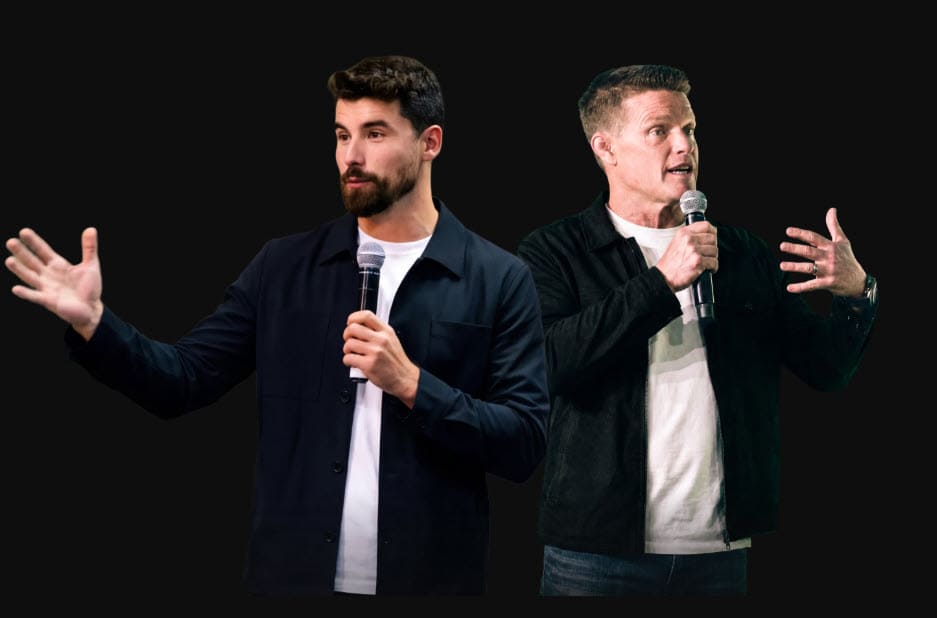
Gadzhi has run three prior similar free-to-paid challenge events, and Brunson co-founded ClickFunnels, a funnel-building software company he says has paid out more than $200 million in affiliate commissions historically. That claim comes from Brunson himself in a recorded conversation about this launch, not from an independently audited source — but it’s a relevant data point if you’re trying to judge whether this team has a track record of actually paying affiliates on past programs.
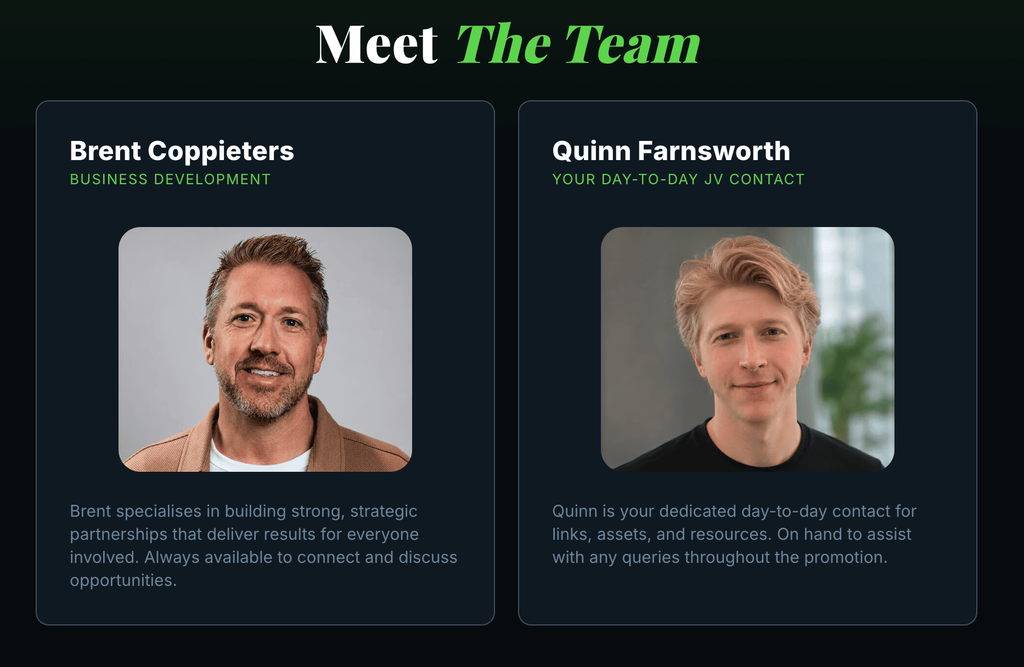
The program is run under Marketing Secrets LLC, listed with a physical address in Eagle, Idaho, on the JV page. Day-to-day affiliate support is handled by a company called PrimeMover, with two named contacts: Brent Coppieters (listed as handling business development) and Quinn Farnsworth (listed as the primary day-to-day JV contact for links, assets, and resources). Both have publicly listed email addresses on the partner page.
How Does the Affiliate Program Actually Work?
Here’s the sequence, based on the JV page and the recorded planning session:
1. You register as a partner. The sign-up form asks for your first name, last name, email, and phone number — nothing more. There’s no visible application, audience-size requirement, or approval step described on the public page, despite the “invitation only” language at the top.
2. You receive a tracking link and dashboard access. Once confirmed, the JV page states you get a personal tracking link, access to a partner dashboard, and promotional assets. In the recorded strategy session, Bill Allen (who is running the affiliate side of this specific launch) mentions providing email copy, swipe files, and a login where affiliates can monitor their leads and sales in real time.
3. You promote starting around the organic promotion date. The JV page lists August 17 as the date both organic and paid promotion are cleared to begin. It’s worth noting that in the recorded strategy session, Russell Brunson references August 10 as the start date for organic promotion during his talk to an in-person group. That’s a week earlier than what the official partner page states. This kind of date drift is common as a launch gets finalized, but it means you should confirm the current start date directly with your affiliate contact rather than relying on any single source, including this one.
4. The event runs, and your referrals move through the funnel. Referred leads go through the free opt-in, the $15 VIP upsell, the $25 Fast-Track Kit, and then the core paid offer pitched live during the event sessions.
5. Cart closes and commissions are calculated. The JV page lists September 15 as the final cart-close date, matching the roughly “8 days after cart open” timeline described in the strategy session (cart opens around September 7).
What Do Affiliates Actually Get?
A tracking link and partner dashboard. Standard for affiliate programs — lets you see opt-ins and sales tied to your link.
Promotional assets. According to the recorded planning conversation, this includes email swipe copy and marketing materials built by the internal team, meant to reduce the work of writing your own promotional emails from scratch.
Two-tier commission structure. The strategy session describes a first-tier rate of 40% on direct referrals, plus a second-tier rate of 10% on sales made by any sub-affiliates you personally recruit into the program. That second tier matters if you have relationships with other creators or marketers you could bring in under you.
Entry into two simultaneous contests. More detail on this below, since the prize structure is one of the more eye-catching parts of the offer.
A dedicated JV contact. Quinn Farnsworth is named as the point of contact for questions about links, assets, and resources during the promotion window — a real, named person rather than an anonymous support inbox, which is a small but meaningful trust signal.
Commission Structure and Contest Prizes: The Numbers
| Element | What’s Documented |
|---|---|
| Per-customer earning potential | Up to $1,032 per customer, according to the JV page, calculated across the full funnel (free-to-paid upsells plus the core offer) |
| First-tier commission rate | 40%, per the recorded strategy session |
| Second-tier commission rate | 10% on sales made by affiliates you personally recruit |
| Core offer value | $1,995 |
| One-time upsell (OTO) value | $995 |
| Two smaller upsells | $25 each |
| Cookie/attribution window | Not specified in any of the available materials |
| Refund clawback window | Not published on the JV page; a recorded planning conversation for this launch team describes a roughly 30-day cooldown tied to the refund period before a sale is treated as locked in for commission purposes — worth confirming this applies to this specific program |
Opt-In Race (rewards affiliates who generate the most leads before the sales event opens):
- 1st place: $15,000
- 2nd place: $5,000
Sales Leaderboard (rewards total sales volume):
- 1st place: $50,000
- 2nd place: $25,000
- 3rd place: $15,000
- 4th place: $10,000
- 5th place: $7,500
The JV page states the combined total prize pool is $122.5K. Adding up the individual prizes listed above actually totals $127,500 — a $5,000 discrepancy. This is a minor inconsistency, and it’s the kind of thing that’s easy to overlook on a fast-moving launch page, but it’s worth pointing out simply because precision matters when a program is making specific dollar claims. If prize accuracy matters to your decision, it’s a fair thing to ask your JV contact to clarify.
Main Benefits of This Affiliate Program
Two established co-hosts, not one. Promoting an offer backed by two people with long track records in online education — rather than a single, newer creator — generally means more brand recognition for your audience and a higher likelihood the underlying event actually happens as scheduled.
A genuine two-tier structure. Not every affiliate program offers a second-tier override. If you know other creators or marketers who might want to promote this too, the 10% override gives you a reason to recruit them, adding a layer of income beyond your own direct sales.
Contests reward both volume and quality. Running two leaderboards — one for opt-ins, one for actual sales — means affiliates with smaller but highly engaged audiences aren’t automatically shut out by affiliates who can generate huge raw lead volume but fewer buyers.
Real promotional support. A named day-to-day contact and provided swipe copy reduce the friction of getting started, which matters if you’ve never promoted a multi-step funnel like this before.
Limitations and Drawbacks
Commission math isn’t fully transparent. The 40%/10% tiered rates are described in a recorded conversation, not stated plainly on the public JV page itself, which only gives the blended “$1,032 per customer” figure. If you multiply 40% across the full $3,040 in combined product value ($1,995 + $995 + $25 + $25), you’d expect closer to $1,216 per customer, not $1,032. That gap suggests the 40% rate may not apply evenly across every item in the funnel — but the JV page doesn’t break this down product by product, so you’re left estimating rather than knowing your exact payout per sale.
Restricted keyword bidding for paid traffic. In the recorded planning session, the team is explicit that affiliates running paid ads cannot bid on “Iman Gadzhi,” “Russell Brunson,” or “Side Hustle Summit” as keywords. That’s a standard brand-protection rule, but it does limit one of the more efficient paid traffic strategies (branded search) that some affiliates rely on.
Refund exposure isn’t fully spelled out for this launch specifically. The roughly 30-day cooldown mentioned in the strategy session was described in the context of how this team’s launches have generally worked, not confirmed as the exact policy for this program. Given that the core offer’s own refund terms aren’t published anywhere in the public materials either, this is one of the bigger open questions for affiliates who care about how quickly and reliably commissions get locked in.
“Invitation only” framing doesn’t match the open sign-up form. The JV page repeatedly emphasizes exclusivity, but the registration form asks for nothing more than a name, email, and phone number — no application, no audience verification, no approval gate visible to the applicant. Separately, the recorded event replay this review draws from shows Russell Brunson inviting a much broader public audience (people watching a recorded replay, not just an in-person mastermind group) to sign up at the same JV page. That’s not evidence of dishonesty, but it does mean “invitation only” functions more as marketing language than a literal gatekeeping mechanism, and affiliates shouldn’t assume they’re joining a small, hand-picked group just because the page says so.
Who Should Apply for This Affiliate Program?
- Creators or marketers whose audience already has interest in online business, digital products, or AI tools — the underlying event content is squarely aimed at that group
- Affiliates comfortable promoting a multi-step funnel (free event → small upsells → large core offer) rather than a single, simple product
- People with relationships to other marketers they could bring in under the second-tier commission structure
- Affiliates who’ve promoted Brunson or Gadzhi offers before and already have a sense of how their audience responds to this type of content.
Who Should Skip It?
- Affiliates who need fully documented cookie windows and per-product commission rates before committing ad spend
- Anyone planning to run paid search campaigns that rely on bidding for the hosts’ names or the event name — that’s explicitly against the rules described
- Affiliates whose audience is unlikely to respond to a “beginner-friendly, AI side hustle” pitch — the messaging is built for a broad, less experienced market, and it may not land with an audience of already-established marketers or business owners
- Anyone uncomfortable promoting an offer where the biggest, highest-commission product (the ~$1,995 core program) isn’t priced or detailed anywhere your audience can see before they attend the live event
Is the Side Hustle Summit Affiliate Program Legit or a Scam?
Based on the available evidence, this is not a scam in any meaningful sense. There’s a real, scheduled event, a named affiliate management team, a documented commission structure (even if not every detail is public), and hosts with long, verifiable histories running similar online education businesses. Affiliates who sign up appear to get an actual tracking link, real assets, and a real shot at the listed contest prizes.
That said, “legitimate” and “fully transparent” aren’t the same thing. The gaps outlined above — unclear cookie duration, unclear per-product commission math, a refund policy for the core offer that isn’t published anywhere, and the mismatch between “invitation only” messaging and an open registration form — are the kind of details a cautious affiliate should get in writing before promoting heavily, especially if you’re planning to spend money on paid traffic rather than just emailing an existing list.
Is It Worth Joining as an Affiliate?
That depends on how you weigh a strong-sounding commission structure against several unconfirmed details.
If your audience is already a good fit for this type of content, and you’re planning to promote through free channels like email or organic social rather than paid ads, the downside risk is low — you’re not spending money upfront, and the contest structure gives you a shot at meaningful bonus prizes even if your direct commissions are modest. In that scenario, joining and testing a small promotion is a reasonable way to evaluate the program firsthand.
If you’re planning to invest paid ad spend, or if your business depends on knowing exact commission rates and refund terms before you commit, it’s worth pushing your JV contact for written clarification on the open questions above before you scale up any campaign. A program can have a genuinely attractive top-line structure and still leave affiliates exposed if the fine print isn’t nailed down in advance.
Pros and Cons
Pros
- Backed by two hosts with long, documented histories in online marketing education
- Two-tier commission structure (40% direct, 10% override on sub-affiliates)
- Two simultaneous contests rewarding both lead volume and sales
- Named, reachable affiliate support contacts
- Low cost of entry — signing up itself is free
Cons
- Exact per-product commission rates aren’t published; the math doesn’t cleanly reconcile with the stated $1,032 figure
- Refund policy for the largest, highest-commission product isn’t documented anywhere reviewed
- Restrictions on bidding for the hosts’ names limit certain paid traffic strategies
- “Invitation only” framing doesn’t match an open, unscreened sign-up form.
Final Verdict
Consider joining if you have an audience already interested in online business or AI-driven side hustles, you’re planning to promote through organic channels rather than paid ads initially, and you’re comfortable confirming the unpublished details directly with the affiliate team before scaling your effort.
Skip it if you need every commission detail, cookie window, and refund policy documented in writing before you commit any real time or budget — several of those specifics simply aren’t public yet in the materials available.
The single most important reason behind this recommendation: the program’s top-line numbers look genuinely competitive, and the team behind it has real experience running similar launches. Thus, I highly recommend it.
Frequently Asked Questions
What is the Side Hustle Summit Affiliate Program?
It’s the JV partner recruitment arm for Side Hustle Summit, a free event hosted by Iman Gadzhi and Russell Brunson, offering commissions to affiliates who refer customers into the event’s funnel and paid upgrades.
How much can affiliates earn?
The official JV page states affiliates can earn up to $1,032 per customer across the full funnel. A recorded planning session for this launch describes a 40% first-tier commission rate and a 10% second-tier override on sub-affiliates you recruit, though the exact per-product breakdown isn’t published.
Is the Side Hustle Summit Affiliate Program legit?
The available evidence suggests it’s a real, structured program with named contacts, documented contest prizes, and hosts with long histories in online education. Several details — cookie duration, refund policy for the core offer, exact commission tiers — aren’t publicly documented, which is worth confirming before promoting heavily.
Is it really invitation-only?
The JV page describes it that way, but the public sign-up form only asks for a name, email, and phone number, with no visible screening step. A recorded event replay also shows the hosts inviting a broad public audience to the same registration page, suggesting the exclusivity language may be more of a positioning device than a strict gate.
Are there restrictions on how affiliates can promote it?
Yes. According to the recorded strategy session, affiliates running paid ads cannot bid on the hosts’ names or the event name as keywords.
Is there a cost to join as an affiliate?
No documented cost to register as a JV partner is mentioned in any of the reviewed materials.
What happens if a referred customer requests a refund?
This isn’t published for the core offer. A recorded planning conversation for this launch team describes a roughly 30-day cooldown tied to refunds on past programs, but it’s not confirmed in writing for this specific launch.
Is the affiliate program worth joining?
It’s worth testing on a small scale through free promotional channels if your audience fits the niche. It’s worth getting written clarification on commission math, cookie windows, and refund terms before investing paid ad spend
